Women Empowerment Through NGO Livelihood Programs in Tamil Nadu — From Dependency to Economic Independence
"Economic independence is not just about income. It is about the confidence to make decisions, the freedom to choose, and the standing in a community that comes when a woman earns her own way."
In rural Tamil Nadu, the economic position of women in households has been shaped by generations of limited formal employment, restricted access to financial systems, and social norms that have defined women's economic contribution as secondary to men's. These patterns are changing — but they are not changing fast enough on their own. NGO livelihood programs designed specifically for women are among the most effective tools available to accelerate this change.
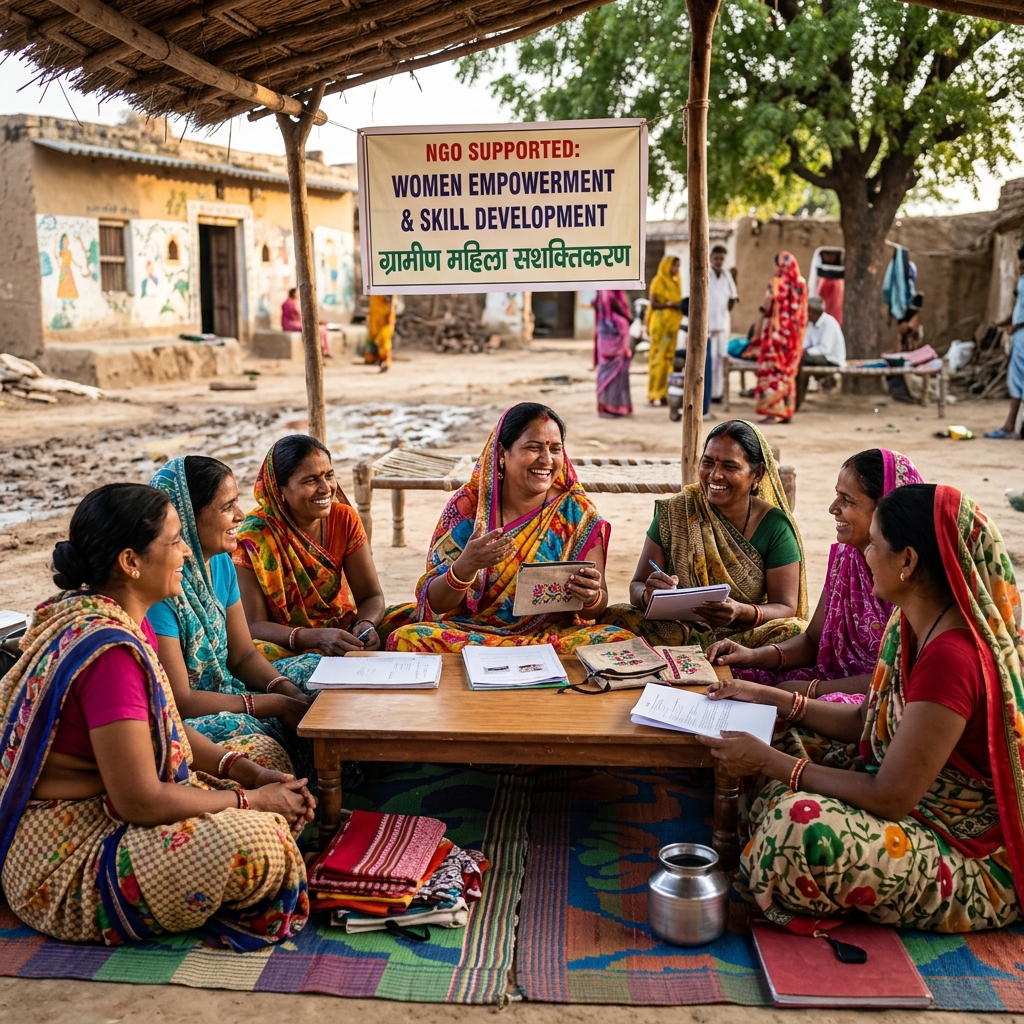
Sundaram Ammal Foundation's women's livelihood programs operate on a clear premise: when a woman gains economic independence, the benefit does not stay with her alone. It reaches her children's education, her household's health decisions, her standing in the community, and the expectations placed on the next generation of women in her family. Women's economic empowerment is therefore not just a gender issue — it is a community development issue.
Support Women's Economic Independence in Tamil Nadu
Fund, volunteer, or partner with Sundaram Ammal Foundation to expand women's livelihood programs across rural Tamil Nadu.
Donate NowWhat Women Empowerment Through NGO Livelihood Programs Actually Looks Like
The phrase 'women empowerment' is used so broadly that it can mean almost anything. In the context of NGO livelihood programs, it means something specific: a measurable change in a woman's economic capacity and the social standing that economic capacity creates. This change is produced through a connected set of interventions — not a single skill training session.
Vocational Skill Training That Connects to Real Income
The foundation of a livelihood program is a skill that produces income. The most effective NGO livelihood programs in Tamil Nadu teach skills with clear local market demand — tailoring, food processing and value addition, handicrafts with established sales channels, agricultural productivity enhancement, and increasingly, digital skills that open online income pathways. The critical distinction is that the skill taught must connect to an accessible income opportunity — not to a hypothetical one.
Sundaram Ammal Foundation's livelihood programs are designed around this principle. Before a skill is taught, the local economic context is assessed: who are the buyers, what is the realistic income range, what additional support — equipment access, market connections, financial capital — does a woman need to convert the skill into income? The program design reflects these realities.
- Tailoring and garment stitching linked to local market demand
- Food processing and value addition with supply chain support
- Handicrafts with established sales channels
- Agricultural productivity and allied income activities
- Digital skills opening online income pathways
Financial Literacy as the Foundation of Economic Sustainability
A skill without financial literacy produces income that leaks away through poor financial management, vulnerability to predatory credit, and inability to invest in growing the livelihood. NGO women's livelihood programs that integrate financial literacy — teaching participants to maintain basic accounts, evaluate credit products, access government savings schemes, use digital banking, and plan for business growth — produce significantly more sustainable economic outcomes than skill training alone.
Women in rural Tamil Nadu who have never managed a formal bank account, who have relied on informal moneylenders for credit, and who have no experience of financial planning are not less capable of financial management — they have simply never been given the tools or the context. Financial literacy training provides both, in Tamil, at the community level, in a setting where questions can be asked without embarrassment.
Self-Help Groups as the Infrastructure of Collective Empowerment
Self-help groups remain one of the most proven structures for women's collective economic empowerment in India. An NGO livelihood program that connects women to functioning SHGs provides more than a support group — it provides access to collective savings, group credit at reasonable rates, peer accountability and encouragement, shared knowledge and market information, and a social platform that increases each member's community standing.
Sundaram Ammal Foundation supports SHG formation and strengthening as a core component of its women's livelihood work. The group structure amplifies the impact of individual skill training and provides the financial infrastructure that individual livelihoods need to grow.
- Access to collective savings and group credit at reasonable rates
- Peer accountability, encouragement, and shared knowledge
- Market information and shared business opportunities
- Social platform that increases each member's community standing
Digital Work and Online Income Pathways for Women
Smartphone access has created a new livelihood category for women in rural Tamil Nadu: digital work that generates income without requiring women to leave their communities. Online reselling through platforms like Meesho, Tamil content creation, social media management for local businesses, online tutoring, and basic data entry work are all income pathways that women with basic digital literacy can access from home.
For women whose mobility is constrained by family responsibilities, household obligations, or community expectations, digital income pathways are not a second-best alternative to conventional employment — they are often the best available pathway to economic participation. NGO livelihood programs that include digital literacy and online work training recognise this and build it into their program design.
Sundaram Ammal Foundation's women's livelihood programs are free of cost, delivered in Tamil, and designed to be accessible to women with no prior skill or formal education background. We bring programs to community venues so that participants do not need to travel to access them.
Free
All programs — zero cost to participants
Tamil
Delivered in Tamil at community venues
0+
No prior skill or education required
Why NGO Livelihood Programs for Women Produce Lasting Change
The most durable change produced by women's livelihood programs is not the income — it is the shift in how a woman sees her own capability and how her family and community see her. A woman who earns independently, who manages her own money, who contributes visibly to household economics, occupies a different social position than one who does not. This shift in social position — in respect, in decision-making authority, in the expectations placed on her daughters — is the deepest form of empowerment and the one most likely to persist across generations.
NGOs that understand this design programs that support the whole journey: from the first skill learned through the first income earned through the gradual accumulation of economic standing and social confidence. Sundaram Ammal Foundation's women's livelihood programs are designed with this full journey in mind.
"Economic independence is not just about income. It is about the confidence to make decisions, the freedom to choose, and the standing in a community that comes when a woman earns her own way."
Frequently Asked Questions — Women Empowerment Through NGO Livelihood Programs
Support Women's Economic Independence in Tamil Nadu
Fund, volunteer, or partner with Sundaram Ammal Foundation to expand women's livelihood programs across rural Tamil Nadu.
sundaramaf.org  | director@sundaramaf.org  | +91-98421-60709