 Are
you ready to help them? Let's become a volunteer...
Are
you ready to help them? Let's become a volunteer...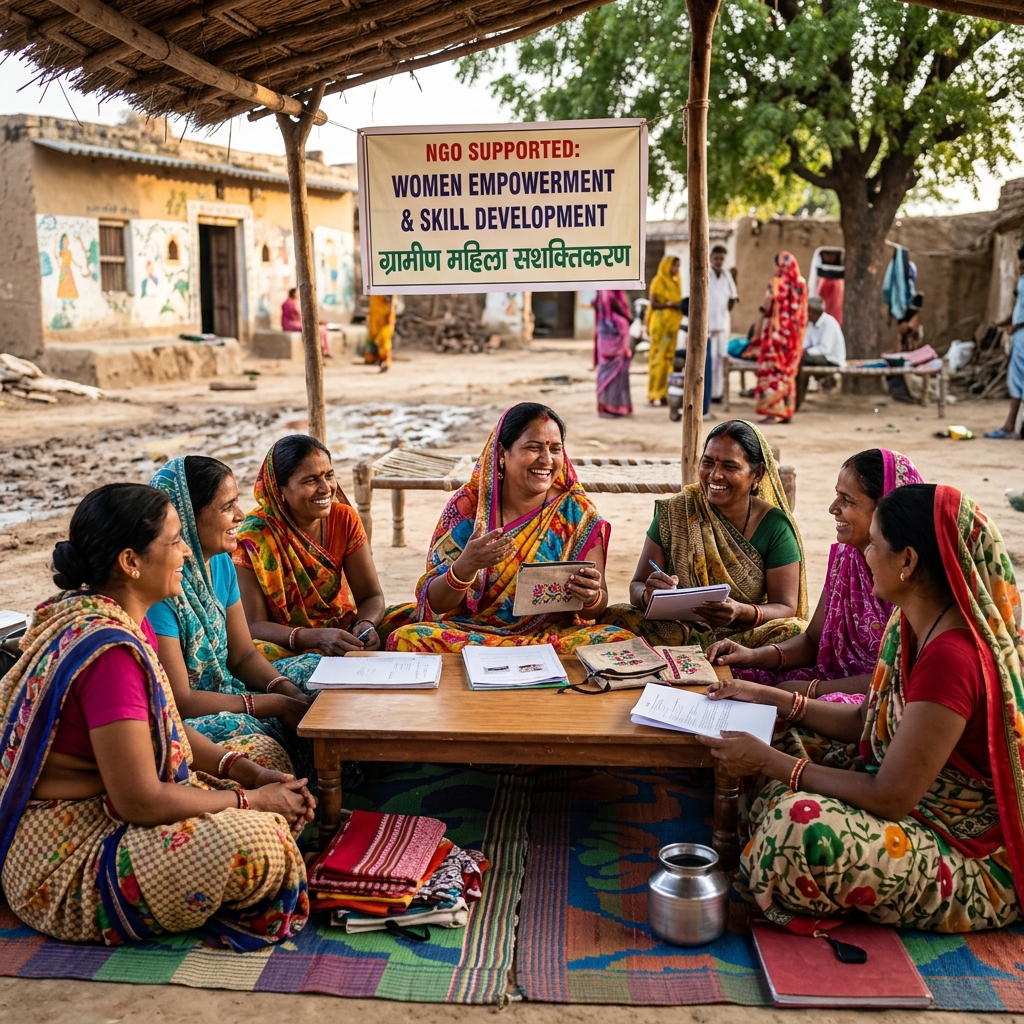
Women Empowerment Initiatives by NGOs in India — How Community Organisations Are Changing Women's Lives
“When a woman in a rural village gains an income, she does not just change her own life. She changes the trajectory of her children, her household, and her community.â€
Women\'s empowerment has been a stated priority of Indian policy for decades. Yet across rural Tamil Nadu and much of the country, millions of women continue to face barriers that formal policy cannot easily reach: limited mobility, social expectations that restrict economic participation, lack of access to skill training, and financial systems that were not designed with their needs in mind. It is in this gap — between policy intention and community reality — that NGOs working on women empowerment initiatives are making their most significant contribution.
Sundaram Ammal Foundation\'s programs for women in Tamil Nadu are built on a simple recognition: women\'s empowerment is not a single intervention. It is a connected set of changes in awareness, skill, economic access, and community standing that must be built together, in the right order, with patience and trust.
What Women Empowerment Initiatives by NGOs in India Actually Involve
The phrase \'women empowerment\' covers a wide range of activities, and NGO approaches vary significantly. The most effective initiatives address multiple dimensions of women\'s lives simultaneously rather than treating economic training or awareness in isolation.
Across India, NGOs running women empowerment programs typically work in some combination of the following areas: economic skill development and livelihood training, financial literacy and access to banking and microfinance, digital literacy and access to technology, legal awareness and rights education, health and nutrition awareness, self-help group formation and peer support networks, and leadership development for women in community governance.
The most impactful programs connect these elements rather than delivering them in isolation. A woman who learns a vocational skill but has no financial literacy cannot manage the income it generates. A woman who understands her rights but has no economic independence cannot act on them. Sundaram Ammal Foundation\'s approach to women\'s programs reflects this integrated understanding.
Key Women Empowerment Initiatives by NGOs in Tamil Nadu
Livelihood and Vocational Skill Training
Skill training remains the most direct economic empowerment intervention. NGOs in Tamil Nadu deliver vocational programs in tailoring, food processing, handicrafts, agricultural value addition, and increasingly, digital work and online selling. The critical differentiator between effective and ineffective programs is whether the skill taught connects to a real, accessible income opportunity — not just a certificate that sits unused.
Sundaram Ammal Foundation\'s livelihood programs are designed around local economic opportunity — what can a woman in this community actually do with this skill, in this location, with the mobility constraints she faces? This grounding in local reality is what makes skill training translate into actual income.
Digital Literacy and Online Economic Participation
Smartphone access among rural women in Tamil Nadu has grown significantly in recent years. But access to a device is not the same as the ability to use it for economic benefit. NGO digital literacy programs for women cover UPI payments and digital banking, online selling through platforms like Meesho, government scheme enrollment and benefit access, social media for small business promotion, and the basics of digital work that can generate income from home.
For women with mobility constraints — whether due to family responsibilities, cultural expectations, or transportation limitations — digital economic participation represents a path to income that does not require leaving the community.
Financial Literacy and Access to Formal Finance
Many rural women in Tamil Nadu manage household finances but have limited understanding of formal financial systems — banking, insurance, government savings schemes, and microfinance. NGO financial literacy programs demystify these systems, explaining how to open and use a bank account, how to access government schemes like Jan Dhan, PM Mudra, and TNSRLM, and how to evaluate credit products so that women are not exploited by predatory informal lenders.
Financial literacy is also the foundation of small business viability. Women who understand basic accounting, pricing, and cash flow management run more sustainable livelihoods than those who have vocational skills but lack financial management knowledge.
Self-Help Groups and Peer Community Building
Self-help groups (SHGs) are one of the most proven models of women\'s collective empowerment in India. NGOs like Sundaram Ammal Foundation support SHG formation, training, and linkage — helping women build peer networks that provide mutual financial support, shared knowledge, collective bargaining power, and social solidarity. A woman who is part of a strong SHG is economically more resilient, socially more connected, and psychologically more confident than one who is navigating challenges alone.
Sundaram Ammal Foundation\'s women empowerment programs are free of cost and designed to be accessible to women from all economic backgrounds in rural Tamil Nadu. Our programs come to communities — participants do not need to travel to access them.
Why NGO Women Empowerment Initiatives Reach Where Government Programs Cannot
Government women empowerment schemes — TNSRLM, PM Mudra, Mahila Shakti Kendra, and others — are important and reach significant numbers of women. But they have structural limitations: fixed training centres that require travel, language delivery that does not always accommodate Tamil-first learners, enrollment processes that require documentation that marginalised women often lack, and a one-size-fits-all program design that cannot adapt to individual community contexts.
NGOs bridge these gaps through community presence, trust-based relationships with families, Tamil-language delivery, flexible scheduling around household responsibilities, and sustained follow-through after a program ends. They are not competitors to government schemes — they are connectors, bringing women to readiness to access formal programs that would otherwise be out of reach.
All SAF programs are completely free for participants. We believe financial barriers should never prevent a woman from accessing empowerment support.
Frequently Asked Questions — Women Empowerment Initiatives by NGOs
Support Rural Youth Empowerment in Tamil Nadu
Volunteer, Donate, or Partner
with Sundaram Ammal Foundation
sundaramaf.org  |Â
director@sundaramaf.org  | +91-98421-60709
Leave a Reply
Your email address will not be published. Required fields are marked