

 Are
you ready to help them? Let's become a volunteer...
Are
you ready to help them? Let's become a volunteer...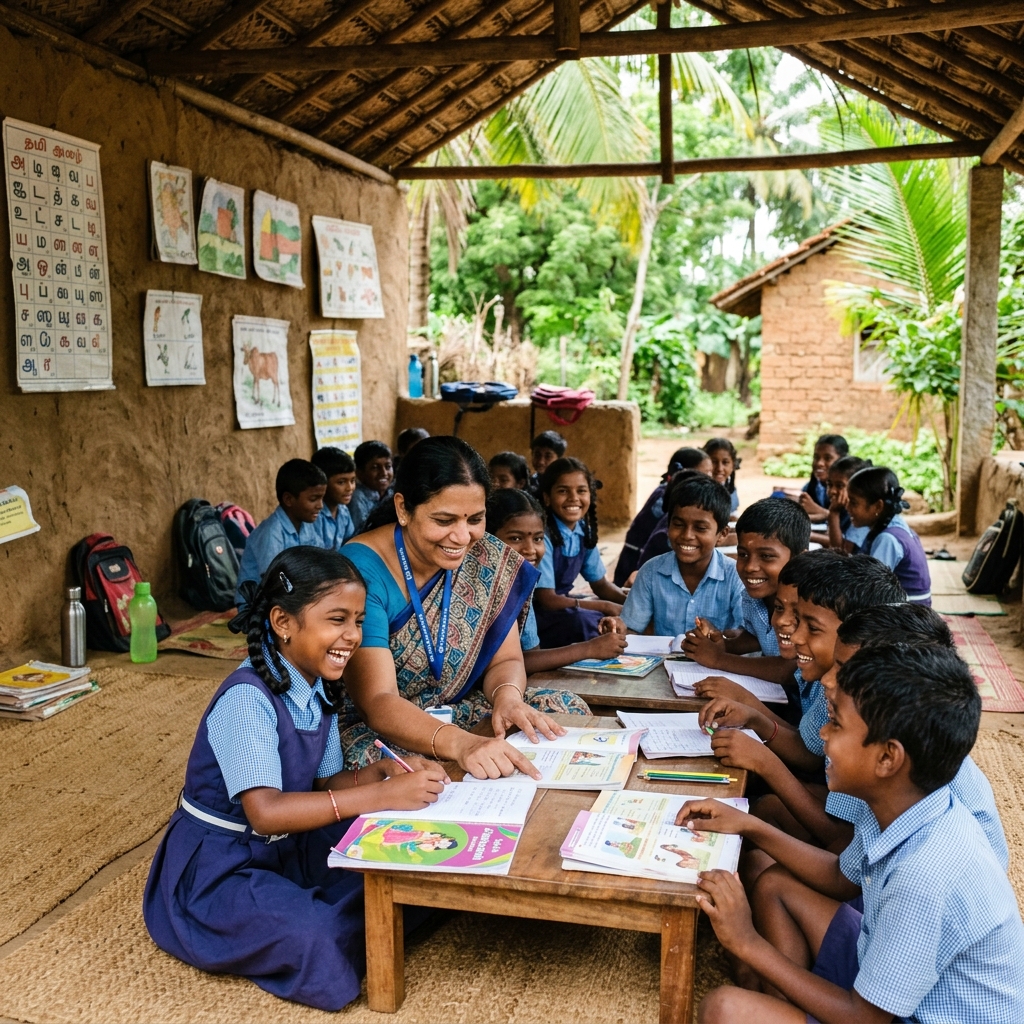
Role of NGOs in Improving Rural Education in Tamil Nadu — Beyond the Classroom
"A school building is the beginning of education. What happens inside it, and what happens after the final bell rings, determines whether education actually changes a life."
Tamil Nadu's literacy rate is among India's highest. Government investment in school infrastructure has produced visible results — classrooms exist in most villages, enrollment rates have improved, and midday meal programs have reduced one of the most common reasons families keep children home. But enrollment is not learning, and literacy is not education in the full sense that the word implies.
The gap between children being in school and children being equipped for productive adult lives remains significant across rural Tamil Nadu — particularly for first-generation learners, children from economically marginalised households, and girls whose schooling is frequently interrupted by household responsibilities. This is the gap where NGOs working on rural education improvement are doing their most essential work.
The Gaps in Rural Education That NGOs in India Are Addressing
Learning Quality Beyond Enrollment
Enrollment statistics measure whether a child is registered in school. They do not measure whether that child is learning. Studies consistently show significant learning deficits in rural government schools — children in upper primary grades unable to read basic Tamil text, students completing 8th standard without foundational numeracy. These deficits are not the fault of teachers alone — they reflect large class sizes, under-resourced schools, and the challenge of teaching children who arrive without academic support at home.
NGOs that provide supplementary learning support — remedial reading programs, numeracy reinforcement, homework assistance, and structured study circles — address these deficits directly. Sundaram Ammal Foundation's education support work operates alongside the formal school system rather than replacing it, filling the gaps that institutional constraints create.
Dropout Prevention and Retention
School dropout in rural Tamil Nadu is driven by economic pressure, early marriage for girls, the need for children to contribute labour at home, and a sense of educational futility when learning outcomes are poor. NGOs that work on dropout prevention address these root causes — not just the symptom of a child not attending school.
SAF's education programs include community engagement with families who are considering withdrawing children from school, awareness building about the long-term economic value of education completion, and practical support that reduces the immediate cost of keeping a child in school. Keeping a first-generation learner enrolled through the critical transition between primary and secondary school is one of the highest-value education interventions an NGO can make.
Bridge Programs for Returned Dropouts
Not every dropout can be prevented. For young people who have already left school — whether at 14 or 18 — NGOs provide bridge education programs that build foundational literacy and numeracy, create pathways to equivalency certification through open schooling systems, and connect youth to skill development opportunities appropriate to their current level. These programs recognise that a young person who left school at 12 is not simply 'uneducated' — they have practical knowledge, community skills, and life experience that formal education systems often ignore.
Digital and Technology Literacy in Rural Schools
Computer access and digital literacy remain significantly unequal between urban and rural schools in Tamil Nadu. NGOs that bring structured digital literacy programs into rural school environments — through computer labs, tablet programs, or smartphone-based learning — give rural students their first exposure to technology in a guided, educational context. This exposure is foundational for navigating a job market that increasingly assumes basic digital competency.
Sundaram Ammal Foundation works alongside schools, families, and communities in rural Tamil Nadu to ensure that children complete their education and arrive at adulthood with the knowledge, skills, and aspirations to build a better life.
How NGOs Improve Rural Education Outcomes — Specific Interventions
After-School Learning Support
Structured after-school programs that provide a safe, quiet place to study, access to books and learning materials, and adult guidance significantly improve learning outcomes for children whose home environments do not support academic work. For children in crowded households where study space does not exist and adults cannot provide academic help, this structured support can be the difference between academic retention and falling irreversibly behind.
Teacher Support and Capacity Building
NGOs that work with teachers — providing teaching aids, supplementary materials, and professional development support — extend their impact through the formal school system. A teacher who understands child-centred learning methods and has access to engaging materials reaches every child in that classroom. This multiplier effect makes teacher support programs highly efficient in terms of impact per investment.
Parent and Community Engagement in Education
In many rural Tamil Nadu communities, parents have limited formal education and do not know how to support their children's schooling beyond sending them to school. NGO programs that engage parents — explaining what their child is learning, how they can create a home environment conducive to study, and why education completion matters economically — build the household foundation that school quality improvements depend on.
Frequently Asked Questions — Role of NGOs in Rural Education
Support Rural Education in Tamil Nadu
Volunteer, donate, or partner
with Sundaram Ammal Foundation to improve education outcomes for children across
rural Tamil Nadu.
sundaramaf.org |
director@sundaramaf.org | +91-98421-60709
Leave a Reply
Your email address will not be published. Required fields are marked