

 Are
you ready to help them? Let's become a volunteer...
Are
you ready to help them? Let's become a volunteer...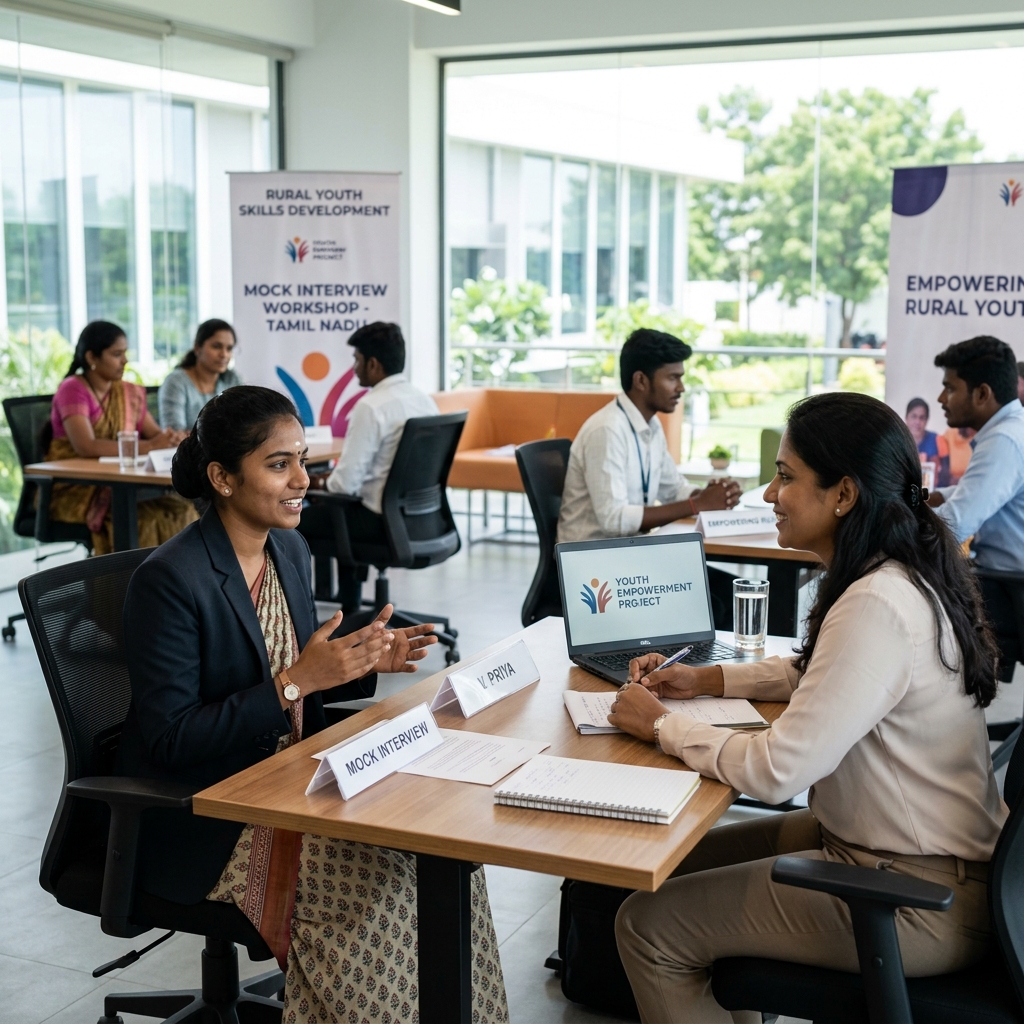
Importance of Interview Training in NGO Skill Programs — Why Preparation Decides Who Gets the Job
“The hardest interview is not the one where you don't know the answer. It is the one where you know the answer perfectly but have never been taught how to say it out loud, to a stranger, in an unfamiliar room.”
Skill training programs across Tamil Nadu have produced thousands of graduates with real, usable competencies. Stitching, computer operation, health assistance, digital content creation, data entry — the skills exist. But a significant number of these graduates are failing at the final stage of the hiring process, not because they lack ability, but because they have never been taught how to present themselves in an interview.
Interview training is one of the most high-impact, low-cost interventions an NGO skill program can include — and one of the most frequently omitted. This blog examines why interview preparation matters so deeply for rural youth, what it should cover, and how Sundaram Ammal Foundation integrates it into skill development programs.
Why Interview Training Is Essential in NGO Skill Programs for Rural Youth
For a student who grew up in an urban professional household, interview preparation is absorbed through environment. They have watched family members dress professionally and discuss work. They have been coached on posture and eye contact. They have access to peer networks who share interview experiences. They may have attended coaching classes that include mock interviews as a matter of course.
For a first-generation job seeker from a rural Tamil Nadu village, none of this background preparation exists. They may have the skill, the qualification, and the willingness to work — but they walk into an interview room with no frame of reference for what is expected, no experience of being assessed formally, and no understanding of how to communicate their own value to a stranger.
The result is predictable: qualified candidates from rural backgrounds are consistently outperformed in interviews by less-qualified candidates from urban backgrounds who simply present better. This is not a meritocracy failure — it is a preparation gap. And it is one that structured interview training can close.
What Effective Interview Training in NGO Skill Programs Should Cover
Understanding What an Interview Is — And What It Is Not
Many rural youth approach their first interview with significant anxiety because they do not understand what the process involves. Interview training begins with demystification: explaining what a hiring manager is actually trying to assess, how long interviews typically last, what the different formats look like (panel vs one-on-one, technical vs HR round), and what is and is not appropriate to say and ask. This basic orientation reduces anxiety and allows the candidate to engage with the actual content of the interview rather than being overwhelmed by the unfamiliarity of the situation.
Self-Presentation and Professional Communication
How a candidate presents themselves — dress, posture, eye contact, speaking pace, and voice clarity — communicates professionalism before a single question is answered. For rural youth who have never been in a formal professional setting, these norms are not obvious. They need to be taught explicitly: what to wear for different types of interviews, how to greet an interviewer, how to sit, how to make eye contact without staring, and how to speak clearly and at appropriate pace.
Tamil is the primary communication language for most rural youth in Thoothukudi and surrounding districts. Many interviews — particularly for government roles and local employers — are conducted in Tamil. But interviews for private sector, BPO, and IT-adjacent roles increasingly involve English. Interview training must prepare candidates for both scenarios, helping them build enough English confidence for the professional context without making them feel that their Tamil fluency is a liability.
Answering Common Interview Questions
Certain questions appear in almost every job interview: tell me about yourself, why do you want this job, what are your strengths and weaknesses, where do you see yourself in five years, describe a challenge you have faced and how you handled it. For candidates who have never practiced answering these questions, the first time they encounter them should not be in a real interview.
Structured interview training walks candidates through each of these questions, explains what the interviewer is assessing with each one, and gives candidates the framework to construct a genuine, confident answer based on their own background and experience. Practice out loud, with a real person listening and giving feedback, is the only way this preparation is fully effective.
Mock Interviews — The Non-Negotiable Component
Reading about interviews does not prepare a person for interviews. Speaking in interviews prepares a person for interviews. Every effective interview training component in an NGO skill program must include multiple rounds of mock interviews — simulated interviews conducted as close to real conditions as possible, with feedback given on content, delivery, body language, and overall impression.
The first mock interview is usually the most revealing. Candidates discover that they do not know what to say about themselves, that they speak too fast or too quietly, that they cannot maintain eye contact, or that their answer to a simple question like 'tell me about yourself' turns into an incoherent two-minute ramble. These problems are entirely fixable with practice — but only if they are identified before the actual interview.
Sundaram Ammal Foundation's skill development programs integrate interview training as a standard component — not an optional add-on. Every student who completes a skill course through SAF receives structured interview preparation, mock interview practice, and career readiness guidance before entering the job market.
The Specific Interview Preparation Needs of Rural Youth in Tamil Nadu
Beyond the universal elements of interview preparation, rural youth in Tamil Nadu face specific challenges that effective NGO programs must address. First-generation job seekers often have a strong internal belief that they are not 'the kind of person' who gets formal sector jobs — a psychological barrier that is as real as any skill gap and that interview training must actively address by building genuine confidence through demonstrated competence in practice settings.
The language dimension is particularly important. Code-switching between Tamil and English mid-conversation — a skill urban candidates develop naturally through exposure — is unfamiliar to rural candidates who have operated entirely in Tamil environments. Interview training that practices this code-switching, even at a basic level, significantly increases comfort in mixed-language interview settings.
Finally, understanding the geography and logistics of a formal hiring process — how to find the interview location, what to bring, when to arrive, how to follow up — is knowledge that urban candidates absorb from their networks and that rural first-time job seekers often simply do not have. Good interview training programs include this practical orientation alongside the communication and content preparation.
Frequently Asked Questions — Interview Training in NGO Skill Programs
Build Career Readiness for Rural Youth in Tamil Nadu
Support Sundaram Ammal Foundation's skill development and interview training programs — free for every participant.
sundaramaf.org |
director@sundaramaf.org | +91-98421-60709
Leave a Reply
Your email address will not be published. Required fields are marked